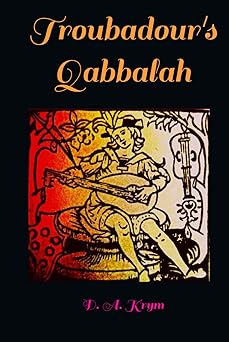
Troubadour’s Qabbalah is not a widely known or established historical or mystical concept. Instead, it combines two distinct but related intellectual and artistic traditions. A book on music, poetry, mysticism, politics and contemporary effects of the past.
The Troubadours, medieval lyric poets and composers, are usually said to be primarily active in Occitania (southern France) from the 11th to the 13th centuries.
This is not the complete historical frame, because, as this book will show, there wouldn’t ever never have been Troubadours without the penetration of the Arabs Omayyades into Spain and the foundation of the Alhambra.
Here we found the real beginning of popular language, with that poetry tradition and the singing through the music of the Oud, that will become the Lute and then the Guitar and the forging of a tongue independent from Latin. From this source the Romance Tongues.
The poetry or the courts, permeated by this way to sing known as canso, focused heavily on courtly love (fin’amor), but also touched upon themes of politics, satire, and morality. Their work was highly structured, employing complex rhyming schemes and musical forms.
The Qabbalah (or Kabbalah) through the mix of that jewish environment of the Diaspora blended with a commercial alliance with Muslims.
The Jewish word Qabbalah is very close to the Arabic Qibla, which is the mystic direction of the prayer, but also the direction for the soul.
Especially the Oriental Jewish Diaspora (which is based on the Zohar, by difference to the Western Diaspora whose exegetical book is the Talmud), it compose an esoteric tradition of Jewish mysticism that seeks to understand the nature of God, the universe, and humanity’s relationship to them.
It uses a variety of methods, including interpreting scripture through numerical symbolism (gematria), analyzing the divine emanations (Sephirot), and studying the structure of each sound.
This book is related also to all the Jewish pretended Messiahs who came after Christ, up to Shabbatai Tzevi and Jakob Frank, The Big Brother.
The phrase “Troubadour’s Qabbalah” is therefore most likely a modern, poetic path to explore the synthesis of their core ideas and, by the way, to learn how music works into our soul.
 Fondazione M