There is a field of study that analyzes the psychological and social responses of communities living near active volcanoes. It’s not a “specific psychology” in the sense of a standalone discipline, but rather an application of emergency psychology, cultural anthropology, and environmental psychology to contexts of volcanic risk. The analysis focuses on risk perception, community resilience, and adaptation mechanisms in the face of a constant but often invisible threat. 
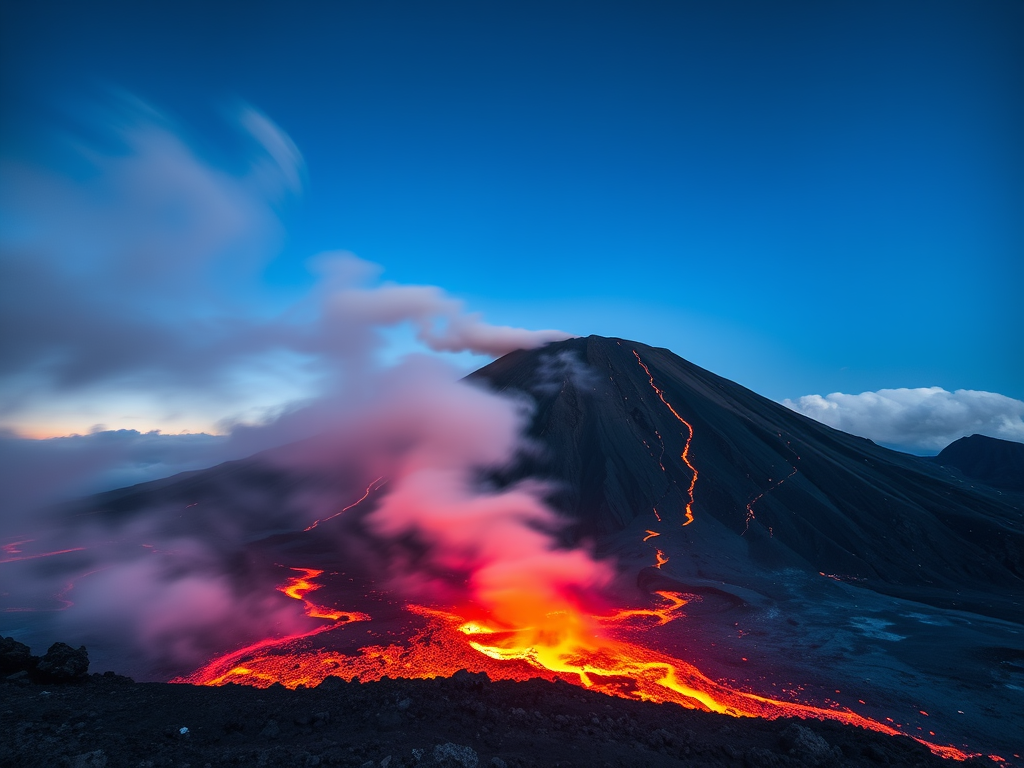
immaginare in modo univoco un simbolo è un errore; provare ad intuire qualcosa che sta oltre i fenomeni è un tentativo: perché sia nobile occorre aggiungere la completa condizione di assenza di ogni interesse concreto e materiale dunque affinché dopo che il corpo sia stato dilaniato dalle Baccanti la testa recisa come Orfeo potrà chiedere alle Muse il canto dei Cronidi Titani, della contesa ch’ebbero con Giove per la successione a Saturno e della rivolta ch’essi condussero contro questo preteso Zeus e qual come Maneteo pretendesse il trono e in che modo Prometeo avesse concepito il piano rendendo parte di questo l’insignificante specie umana e con quali tecniche Atlante valoroso avesse misurato le sue forze e fosse in attesa dell’atteso gesto da parte di Prometeo che nei suoi pensieri contorti ritardava l’ora dell’attacco e come eziandio Tifone impetuoso passionale ruppe gli indugi e sferrò l’attacco: questa fretta questo precipitarsi questo procedere senza punti fu fatale ed accadde quel che sappiamo o che crediamo di sapere o che non sappiamo affatto: Prometeo fu incatenato al Caucaso dal medesmo Zeus; abbagliato dagli occhi di Medusa ch’erano nello scudo di Perseo, Atlante restò pietrificato nella catena montuosa che porta il suo nome; di Maneteo non ci son giunte se non le congetture sull’Atlantide e di Tifone avremo saputo: fu schiacciato sotto l’isola di Sicilia e con lo scudo di Atena ricoperta la voragine di fuoco, Atena di cui Etna è il maglio… magico ascolto il suono del pifferaio, seguilo e troverai le prove trascritte per volute fiammanti, notte in cui il fuoco rivela gli spiriti e ne narra le oscure gesta.
[dall’introduzione a Orogenesi, poema in via di pubblicazione © Fondazione M]
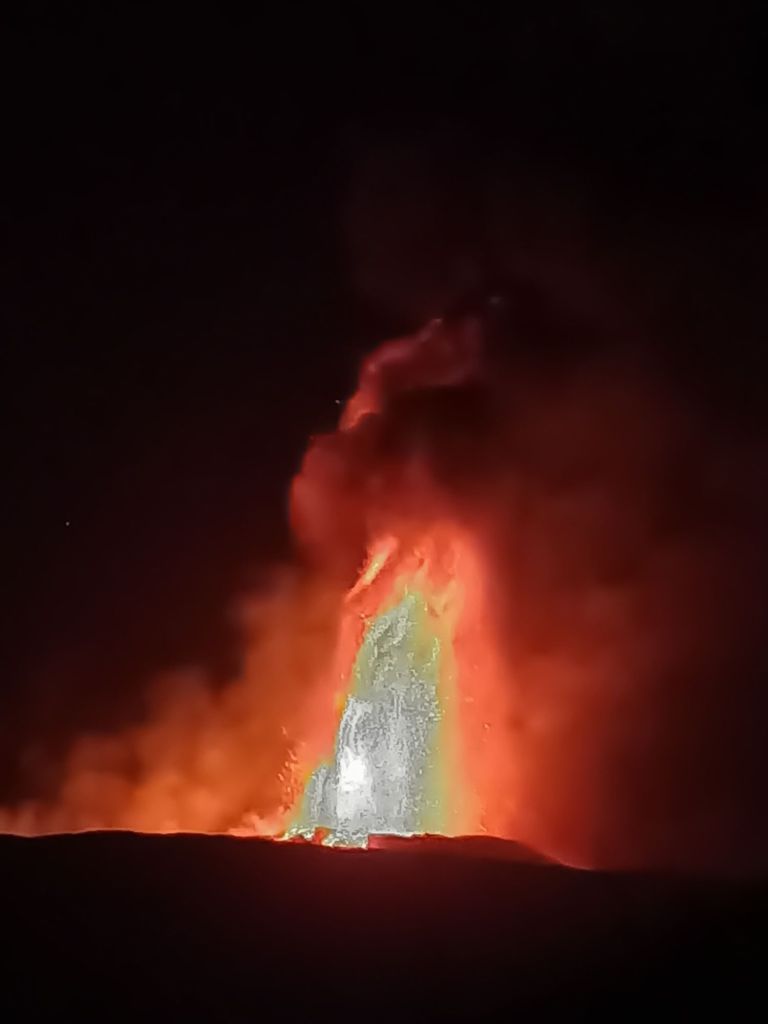
To live near a Volcano:
Psychological and Social Aspects – AI conversation added contents
Volcanic communities develop a complex and often ambivalent relationship with the volcano, which is both a source of danger and a fundamental resource.
- Risk Acceptance: Populations tend to minimize the danger, a psychological mechanism called risk scotomization. This denial is often balanced by an awareness of the benefits that volcanic soil offers, such as fertile land
 and economic opportunities (tourism, geothermal resources).
 - Resilience and Social Cohesion: Communities that have experienced past natural disasters develop a “disaster subculture,” which includes inherited knowledge and collective adaptation strategies. This leads to strong social cohesion and solidarity that is activated in an emergency.
- Stress Management: Prolonged exposure to seismic events or phenomena like bradyseism can generate a state of constant alertness and chronic anxiety. Emergency psychology intervenes to provide support and tools for stress management, helping people maintain clarity and face uncertainty.
- Collective Memory: The volcano is often integrated into local culture through myths, legends, and traditions that strengthen the community’s identity with the territory. This historical memory, while it can lead to underestimating the risk, also contributes to community resilience.
Sources and References
Although the topic is niche, several studies and publications have addressed it. Contributions mainly come from emergency psychology, anthropology, and disaster sociology. Here are some relevant research areas and authors:
- Multidisciplinary Studies: An example is the research conducted in New Zealand by Douglas Paton and others, which integrates psychological and geological perspectives to understand social vulnerability related to eruptions. This type of research highlights the importance of risk communication and emergency planning.
- Scientific and Academic Publications: Articles and essays on “disaster psychology” or “community resilience” in environmental risk contexts are available in specialized academic journals. You can find references in articles that study responses to specific natural disasters, such as those related to Vesuvius or the Phlegraean Fields in Italy.
- Narrative and Non-fiction Literature: Although not “scientific” sources, literature has often explored the relationship between humans and volcanoes. Novels like “Under the Volcano” by Malcolm Lowry describe the sense of precariousness and anguish that can come from living near an impending threat.
For more specific and in-depth research, it is advisable to consult academic archives and research institutions specializing in volcanology and civil protection, which often collaborate with psychologists and social scientists.
And what about mystical aspects of reincarnation connected to Mount Fuji?
Mount Fuji is much more than just a volcano; it is a cultural icon and a place of deep spirituality in Japan. While reincarnation in the strict sense (the soul’s return to a new body) is not a central belief in the specific cult of Fuji, the mountain is closely connected to mystical concepts of transformation, purification, and spiritual rebirth.
Here are some mystical and symbolic aspects linked to Mount Fuji, the Mountain as a Dwelling of Deities and Spirits: in Shintoism, Japan’s indigenous religion, mountains are considered sacred and inhabited by deities (kami). Fuji is revered as the home of Konohanasakuya-hime, the “cherry blossom princess,” a Shinto deity associated with life, beauty, and the power of nature. Climbing Fuji is seen as an act of pilgrimage, a way to get closer to this deity and receive her blessing.

- Purification and Spiritual Rebirth: The concept of “rebirth” is fundamental for pilgrims who climb Fuji. This does not refer to reincarnation into a new life, but to a spiritual rebirth obtained through the climb. The journey, with its hardships and beauty, symbolizes the journey of life, a path of purification and inner growth. Reaching the summit is seen as the attainment of a new self—a purified and enlightened self.
- The “Womb” Caves (O-tainai): At the base of Mount Fuji, there are volcanic caves that have been used as places of worship. Their name, “O-tainai” (meaning “inside the womb”), symbolizes the maternal womb of the earth. Passing through them in a ritual is considered an act of ritual “rebirth,” a rite of passage that symbolizes a return to life with a new awareness.
- Fuji and Shugendō: Shugendō is a syncretic ascetic religion that combines elements of esoteric Buddhism, Shintoism, and animism. Its practitioners, called yamabushi, retreat to the mountains to practice austerity and attain spiritual powers. For the yamabushi, climbing Fuji is not just an act of faith, but an ascetic practice for achieving enlightenment, a path that leads to spiritual “Awakening” and the transcendence of the self.
- Fuji in Literature and Art: Fuji is a recurring theme in Japanese literature and art, often represented as a symbol of immortality. In the famous 10th-century tale, The Tale of the Bamboo Cutter, the emperor orders an elixir of immortality to be burned on the summit of Mount Fuji, giving rise to one of the possible etymologies of the name “Fuji” as “fushi,” meaning “non-death” or “immortality.” This legend, while not speaking of reincarnation, reinforces the idea that the mountain is a place where one can escape the transience of life.
In summary, Mount Fuji is a mystical place that, more than being linked to a strict idea of reincarnation, is a powerful symbol of purification, rebirth, and spiritual immortality within Japanese culture and religious traditions.
And what about the paintings of Nicholas Roerich, and the mysticism of fire in the peaks?
The paintings of Nicholas Roerich represent a profound mysticism of the peaks, which is not directly about reincarnation but rather about spiritual elevation, purity, and the interconnectedness between humanity and the cosmos. The Russian artist, esotericist, and mystic spent a large part of his life studying Eastern philosophies and traveling in Central Asia and the Himalayas, which became the focus of his work.
The Mysticism of Fire
The “fire” in Roerich’s peaks is a symbolic, not a physical, element. It is not a volcanic eruption, but an inner light, a spiritual energy that emanates from the mountains themselves and is reflected in the heavens. This mysticism is imbued with concepts from Agni Yoga, a spiritual doctrine founded by Roerich and his wife Helena Blavatsky, which sees “fire” as the foundation of all creation and a cosmic energy that guides the spiritual evolution of humanity.
Symbolism in the Peaks
The mountains, particularly the Himalayas, are for Roerich much more than simple landscape elements. They are seen as:
- Sacred places: The peaks are the meeting point of heaven and earth, where deities and sages dwell. They are symbols of purity, immutability, and eternal wisdom.
- Seats of knowledge: Roerich believed that the legendary city of Shambhala, a spiritual kingdom of enlightenment and knowledge, was hidden in the high mountains. The “fire” that illuminates them is nothing but the light of this secret wisdom.
- Mirrors of the soul: The journey toward the summit represents the spiritual ascent of humanity. The snowy peaks and iridescent skies are a metaphor for the purification of the soul and the attainment of a higher state of consciousness.
In short, the mysticism of fire in Roerich’s works does not refer to a natural phenomenon, but to an esoteric vision in which the peaks are places of intense spiritual energy. This energy, symbolized by “fire,” guides humanity’s path toward enlightenment and inner purification, reflecting a profound connection between the macrocosm and the microcosm.
Nikolaj Roerich’s introduction to Theosophy was primarily through his wife, Helena Roerich, and the intellectual circles he moved in, rather than through a direct meeting with Helena Blavatsky, who died when he was a young man.
The Influence of His Wife and Intellectual Circles
While the exact sources of his first information on Theosophy are not definitively known, it’s clear that the movement was present in the intellectual salons and artistic groups Roerich was involved with in Russia. Some sources suggest that it was Helena Roerich who introduced him to Theosophy after their marriage in 1901. Helena was a key figure in this process, eventually translating Blavatsky’s magnum opus, The Secret Doctrine, into Russian.
The Development of Agni Yoga
Inspired by Theosophical ideas, the Roerichs, after moving to the United States and then India, developed their own spiritual and philosophical system called Agni Yoga. They claimed to have received this new teaching from a spiritual master named Morya, who was also a key figure in Blavatsky’s Theosophical writings. This new doctrine, also known as “Living Ethics,” became a prominent branch of Theosophy, combining its principles with elements from Eastern and Western religions, and Russian Cosmism.
 Fondazione M